Dog Fooding at Proverify
We have been using two simple internal views—one over ChatGPT history, one over GitHub activity—to learn what TokenOps can actually measure before we ask customers for deeper integrations.
What we are actually doing
- Start with exports we already have. We built one internal analysis over ChatGPT conversation history and another over GitHub activity. Neither requires us to claim an integrated enterprise control plane.
- Turn activity into a reviewable population. The useful outputs so far are straightforward: usage and estimated-cost views for ChatGPT; activity, R&D classification, AI-signal and evidence-review views for GitHub.
- Keep the claims narrower than the ambition. We are not yet claiming that a ChatGPT conversation caused a GitHub artifact, that line changes equal productivity, or that a GitHub classifier by itself produces an accounting conclusion.
There is a temptation in enterprise AI to jump from raw usage telemetry directly to ROI, accounting treatment or control conclusions. Our internal dog-food work has been more basic.
We asked: What can we learn from data we already control, with a small amount of normalization and classification?
So far, that has produced two practical internal tools.
1. A ChatGPT usage audit
Our first view is a searchable audit of internal ChatGPT history. It does not try to prove business outcomes. It organizes conversation activity into a more useful management view.
Usage & estimated economics
Conversation-level usage summarized into simple operating views.
Classification & review
Conversation records can be searched, filtered and classified into working management categories.
It gives us a concrete way to inspect usage, estimated cost and working classifications. “Estimated cost” and “value tier” are analytic fields—not audited finance measures or proven business value.
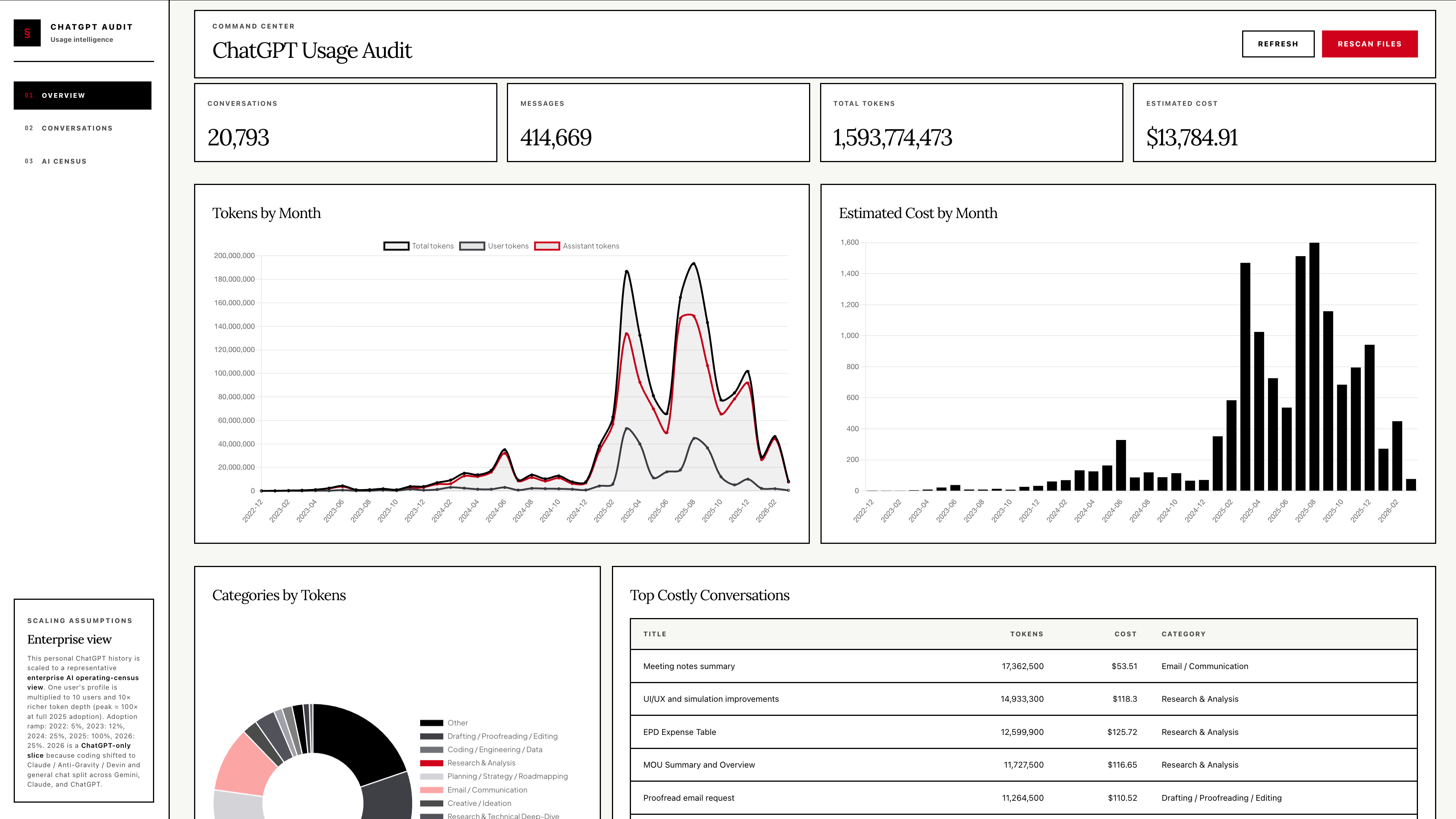 Screenshot: internal ChatGPT usage audit
2. A GitHub R&D activity and capitalization view
The second tool starts from GitHub commits and pull requests. It classifies work by R&D phase and activity type, flags an AI signal where one is detectable, and assigns each work item a working yes / review / no capitalization status with rationale and evidence needed.
- 593 work items across 41 repositories.
- 81 pull requests and 512 commits.
- 1.81M recorded line changes. This is an activity measure, not a proxy for labor, productivity or value.
- Working R&D classification output: 144 yes, 145 review, 304 no — a 24.3% “yes” rate.
- AI signal: 80 explicit, 2 inferred, 511 not detected. A signal indicates available evidence, not the percentage of work performed by AI.
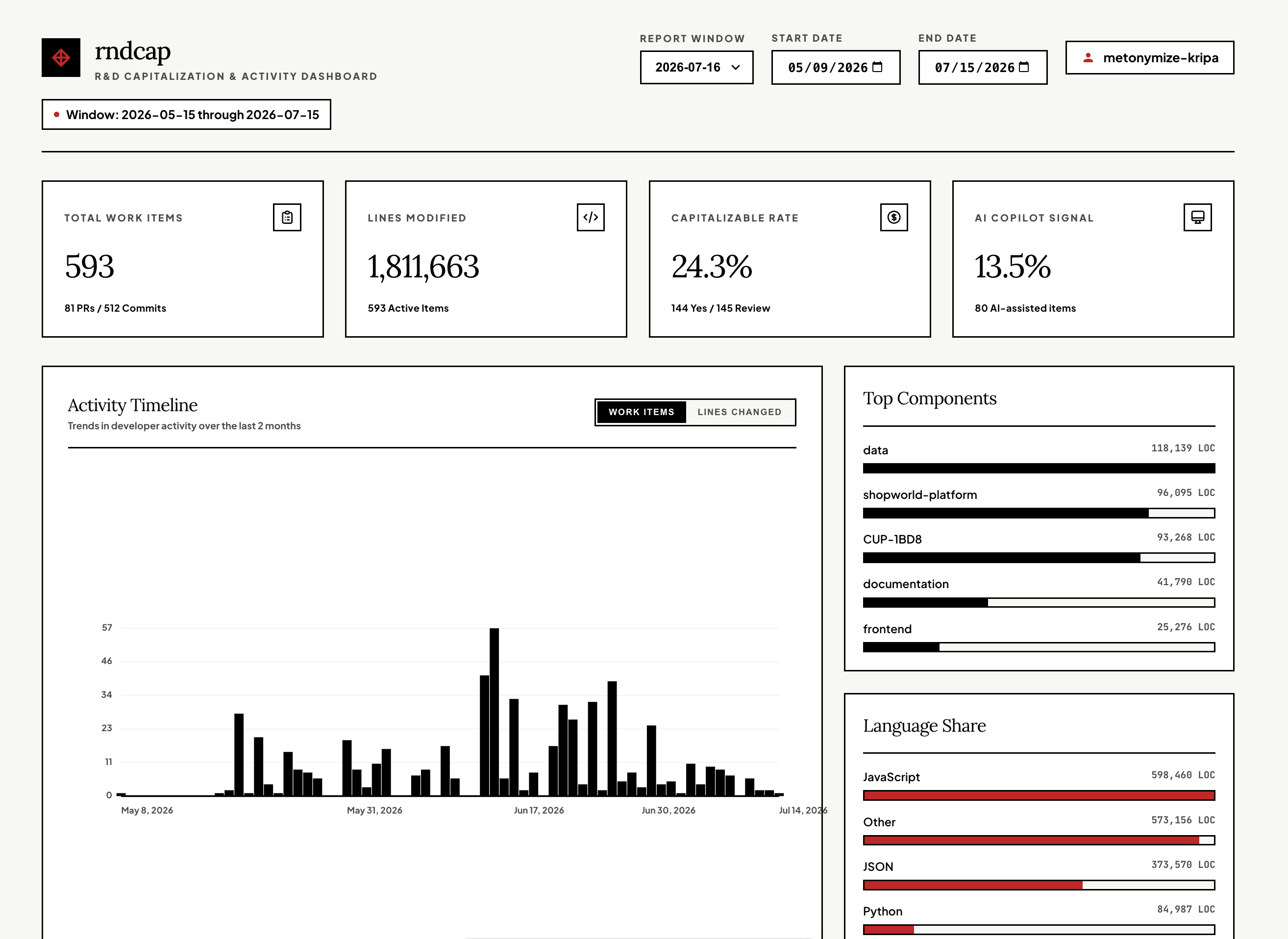 Screenshot: internal GitHub R&D activity and capitalization view
3. What dog fooding is teaching us
The main lesson so far is not that we have solved enterprise AI attribution. It is that relatively simple exports already support a more structured operating file than a collection of screenshots and anecdotes.
4. What we are not claiming yet
Keeping these boundaries explicit is part of the dog-food exercise.
5. Where we go next
The next dog-food steps are deliberately incremental: test whether the two populations can be joined where evidence is strong, add reliable cost and project context, and see whether human review gets materially faster or more complete.
Why this matters for TokenOps
For us, TokenOps is becoming less about producing a bigger AI dashboard and more about building a disciplined path from activity → classification → review → evidence.
Our internal tools are still narrow. That is useful. They let us test the mechanics on real data, expose what the data cannot tell us, and earn the right to add the next layer only where it improves a decision.
Dog food the evidence before selling the conclusion.
Start with what the data actually supports.
Method note
How to read the internal numbers
How to read the internal numbers
The GitHub figures above come from one internal dashboard reporting window. They are presented as examples of the population the tool analyzed, not as productivity benchmarks or external claims.
- Line changes can be heavily affected by generated files, dependencies and large data changes.
- AI explicit / inferred / not detected describes the presence of detectable signal in the source data; “not detected” does not prove that AI was not used.
- Yes / review / no is an internal classification output for the work item. A supportable accounting conclusion requires the relevant project, policy, phase, feasibility, intent and cost evidence.
- ChatGPT estimated cost and value tiers are working analytic fields used in the internal audit dashboard, not audited spend or independently verified value measures.